
Book Notes
DevOps, SRE and Continuous Delivery
Sooner Safer Happier (SSH)
Sooner Safer Happier (2020) -Antipatterns and Patterns for Business Agility
By Jonathan Smart with Zsolt Berend, Myles Ogilvie, and Simon Rohrer
https://itrevolution.com/sooner-safer-happier/
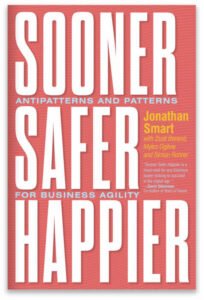
"Really a very good book that I recommend. It offers a very clear synthesis of the different bodies of knowledge (lean, agile, and DevOps) without forgetting more recent works like Team Topologies for example.
The concepts are illustrated by case studies of large companies, which are the main focus of the book."
#businessagility #bvssh #agile #lean #devops #measurements #psychologicalsafety
What We Liked The Most
- The introductory chapter (chapter 0), a must-read for anyone wishing to understand the purpose of agile, lean, and DevOps approaches. Nothing is easier, you can download it from the IT Revolution website: https://itrevolution.com/sooner-safer-happier/.
- The description of the different themes in the form of antipatterns and patterns (even if this necessarily leads to repetitions during a linear reading of the book).
- The style and clarity of writing with simple slogans to remember, such as “Stop Starting, Start Finishing”, “Think Big, Start Small, Learn Fast”, or “Go Slower to Go Faster”.
What Important Lessons We Learned
- “Silence is unhealthy”. Amy Edmondson’s study showing that “the more errors a team reported, the more effective it was… better teams don’t make more mistakes, they’re more willing to report the mistakes they do make”.
- On the same topic, “Organizations reporting the fewest incidents showed the most devastating accidents”. This illustrates the importance of measurement analysis, and the attention to be paid when setting objectives. Should zero-incident or zero-accident be an objective?
- Role-based silos are no exception in the Safety domain: Information Security, Data Privacy, Fraud, …
The Phoenix Project and the Unicorn Project
The Unicorn Project (2019) - A novel about developers, digital disruption, and thriving in the age of data
By Gene Kim
https://itrevolution.com/the-unicorn-project/
The Phoenix Project (2013 => 2018) - A novel about IT, DevOps, and helping your business win
By Gene Kim, Kevin Behr, George Spafford
https://itrevolution.com/the-phoenix-project/
“Essential books for understanding the DevOps movement and its Lean inspirations, in a novel format that perfectly complements the DevOps Handbook.”
#storytelling #theoryofconstraints #leanthinking #devops #technicaldebt #threeways #fiveideals #customervalue
What We Liked The Most
- The effectiveness of the storytelling format. We identify easily with the characters and remember similar or close situations.
- Introduction of theoretical principles using scenarios and practical situations.
- Two companion novels, telling the same story from Ops (Bill) and Dev (Maxine) points of view.
- Human and cultural challenges involved in such transformation.
- Risks of using a ticketing system for communication versus going and meeting each other.
- Psychological safety and blameless culture to ensure that things will improve.
What Important Lessons We Learned
- IT work has a lot in common with manufacturing plant work.
- Theory of constraints, identify and resolve your most important bottleneck (like a dependency to an expert: Brent), one at a time.
- To improve planned work, unplanned work must be reduced to a minimum. Pay down technical debt as a part of daily work.
- The Three Ways (Phoenix project), The Five Ideals (Unicorn project), and The Three Horizons from Geoffrey Moore.
- Focus improvement initiatives on achieving business goals. Be able to measure and demonstrate business and customer value.
Lean, Flow and VSM
Making Work Visible
Making Work Visible (2017) - Exposing Time Theft to Optimize Work & Flow
By Dominica DeGrandis
https://itrevolution.com/making-work-visible-by-dominica-degrandis/
“Knowing where to focus starts with making work and time thieves visible to everyone.
Operational guidance that can be applied immediately.”
What We Liked The Most
- The highly operational approach illustrated by lived situations, making lean, kanban, and agile concepts and principles accessible
- Techniques that can easily be experimented with in order to make quick gains by bringing clarity and visibility (reduce overload, increase focus on what matters most, prevent constant interruptions…)
- Scientific thinking to improve the work by small experiments and empirical observations
- “Many of the problems related to time thievery have to do with organizational problems or company culture”
What Important Lessons We Learned
- How to recognize the five time-thieves: Too much WIP, unknown dependencies, unplanned work, conflicting priorities, and neglected work
- “When everything is a priority one, nothing is a priority one”,
- “Lack of visible data in IT makes us blind”
- “When it comes to efficiency, time is wasted when there is too much focus on resource efficiency over flow-efficiency”
- How to better manage my time using Pomodoro and facilitate Lean Coffee meetings
Value Stream Mapping
Value Stream Mapping (2013) - How to Visualize Work and Align Leadership for Organizational Transformation
By Karen Martin and Mike Osterling
“Without doubt, the essential book and guidance for anyone wishing to discover or improve their value stream mapping practices.”
#valuestream #valuestreammapping #valuestreamtransformation #valuestreammanagement #lean
What We Liked The Most
- Value Stream Mapping is a way to define a strategic direction by a leadership team.
- Practical guidance and templates to prepare, develop and execute a value stream transformation.
The two courses on « Value Stream Transformation » by TKMG Academy are a great complement to the book. - Clear explanations on the visual representation and key metrics.
What Important Lessons We Learned
- “If you can’t describe what you’re doing as a value stream, you don’t know what you’re doing”
- Take time to set the stage with a charter to enable the success of the mapping activity.
- Need of a value stream manager/owner responsible of the entire value stream performance.
Toyota Kata and Toyota Kata Practice Guide
Toyota Kata (2009) - Managing People For Improvement, Adaptiveness, and Superior Results
By Mike Rother
The Toyota Kata Practice Guide (2018) - Practicing Scientific Thinking Skills for Superior Results in 20 Minutes a Day
By Mike Rother
“The essential foundations for a scientific improvement approach based on facts and respect for people’s expertise.
To be applied on a daily basis.”
#toyotakata #improvementkata #behaviorpatterns #coachingkata #problemsolving #goandsee #targetconditions #lean
What We Liked The Most
- Four steps of the Improvement Kata as a practical, everyday scientific way of thinking and working.
- Development of people’s capabilities to continuously understand a situation and improve. Develop scientific skills and mindset in people through the work itself.
- Value Stream Mapping for keeping an eye on the overall picture.
- Five questions of the Coaching Kata in 20 minutes daily sessions.
- Problem-solving approach versus hiding the problem and hunting for solutions.
- Model for changing organizational culture based on repeatedly practicing new behavior patterns.
What Important Lessons We Learned
- Go and see how a process is working to deeply understand the current condition.
- Keep the focus on what really needs to be improved by successive target conditions in the direction of a long-term vision.
- Rely on facts rather than opinions or judgments.
- Change only one thing at a time, so the cause-effect relationship is maintained.
- At Toyota, improving and managing are one and the same.
- Prefer constant daily improvement to occasional improvement projects.
Implementing Lean Software Development
Implementing Lean Software Development (2006) - From Concept to Cash
By Mary and Tom Poppendieck
This book is incredibly rich. It is impossible to summarize its teachings in a few points without omitting major contributions.
In my opinion, this book is the root of all the other books classified under the label ‘DevOps’.
#lean #leansoftwaredevelopment #sevenprinciples #buildqualityin #systemsthinking #productdevelopment #stoptheline
What We Liked The Most
- The Seven Principles of Lean Software Development with their associated common myths.
- The Seven Wastes of Software Development.
- All chapters address topics that are still at the heart of our concerns: customer experience, project versus product, business relationships, design for operations, accountability, psychological safety, leadership, and so on.
What Important Lessons We Learned
- Copying practices without understanding the underlying principles have a long history of mediocre results.
- You can’t sustain high speed unless you build quality in.
- Every time a defect is detected, stop the line, find the root cause, and devise a way to prevent a similar defect from occurring in the future.
- If you focus on driving utilization up, things will slow down.
- Do not undermine team cooperation by rewarding individual performance.
Teams, Outcomes and Leadership
User Needs Mapping
User Needs Mapping (2025) - Aligning Teams Around What Matters
By Rich Allen
https://www.userneedsmapping.com
What We Liked The Most
- An approach focused on users, their needs and outcomes to be achieved.
- A simple entry point to Wardley Maps that sparks insightful conversations about alignment, flow, and value.
- Application to platform teams with their internal users.
- Challenges to adoption and tips for overcoming them.
"Collaborative workshop practices that can be used immediately to refocus and align teams with user needs and deliver value to them more effectively and efficiently."
#userneedsmapping #valuedriven #organizationdesign #wardleymapping #teamtopologies #enterprisearchitecture
What Important Lessons We Learned
- Simple, clear steps to get started on your first pilot project.
- Techniques and workshops that are similar and perfectly complementary to those of Value Stream Mapping, as has been demonstrated in helping Blue Lagoon.
- A practice that creates an accessible bridge between several areas of expertise: customer experience, jobs-to-be-done, enterprise architecture, organisation design, and value stream management.
Team Topologies
Team Topologies (2019=>2025) - Organizing Business and Technology Teams for Fast Flow
By Matthew Skelton and Manuel Pais
https://itrevolution.com/product/team-topologies-second-edition/
“The definitive guide to organising software delivery teams and rethinking their interactions to deliver sustainable business value.”
#teamtopologies #organizationdesign #softwarearchitecture #conwaylaw #teamfirst #cognitiveload
What We Liked The Most
- Clear explanations on the relationship between Organization Design and Software Architecture: Conway’s Law and Reverse Conway Maneuver.
- Descriptions of 4 fundamental Team Topologies to enable the fast flow of software delivery:
- Stream-Aligned,
- Platform,
- Enabling,
- and Complicated Subsystem teams.
- Pragmatic recommendations to take into account a team’s sustainable Cognitive Load.
- The book and its companion website teamtopologies.com provide many industrial case studies.
- The second edition details 10 new case studies illustrating the real-world applications of Team Topologies concepts and principles in different contexts, industries and organisation sizes.
What Important Lessons We Learned
- Involve software architects when thinking about team organization.
- Use of simple visual shapes to collaboratively discuss teams and their interactions.
- Reshape teams’ organization with the evolution of maturity and context changes.
The Five Dysfunctions of a Team
The Five Dysfunctions of a Team (2002) - A Leadership Fable
By Patrick Lencioni
“A pyramid-shaped reference model that lays the foundations for the success of any collective initiative, starting with building trust.”
#teamwork #teameffectiveness #trust #conflict #commitment #accountability #collectiveresults
What We Liked The Most
- The storytelling format (although some characters are a bit cliché)
- The proposed model of the 5 dysfunctions of a team: Absence of Trust, Fear of Conflict, Lack of Commitment, Avoidance of Accountability, and Inattention to Results
- Analogies with team sports on individual behaviors in support of collective results
What Important Lessons We Learned
- Teamwork begins by building trust, which is the foundation for positive contradictory debates (conflicts), enabling commitment and accountability on non-consensual decisions and collective results
- Establish one overarching goal, because “if everything is important, then nothing is”
- The role of the leader is essential to demonstrate expected behaviors and create an environment conducive to build a functional team