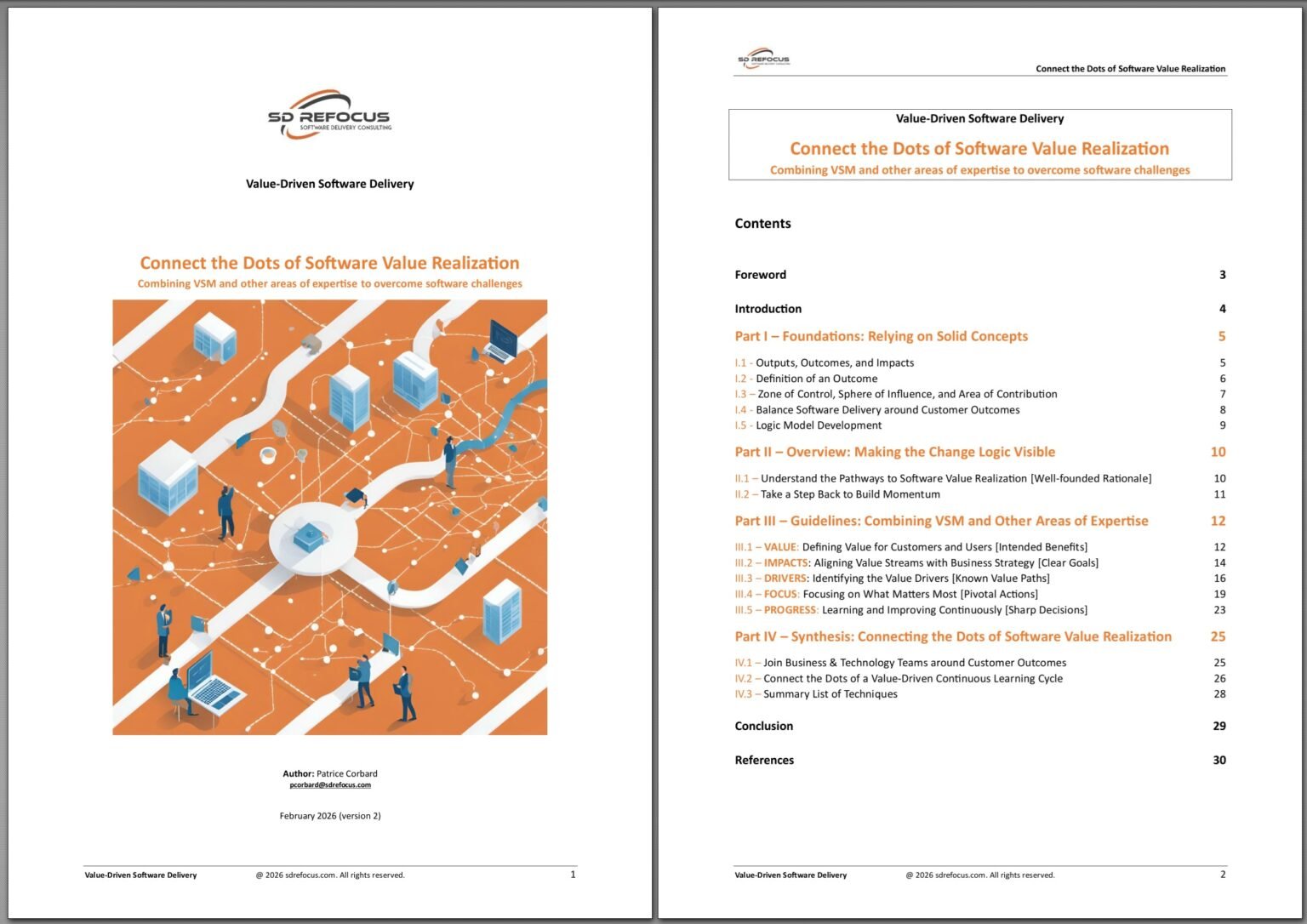
Moving towards Value-Driven Software Delivery
Connect the Dots of Software Value Realization
After about two years of sharing Value-Driven News on LinkedIn and here on sdrefocus.com, this is a synthesis of my own research and experiences.
Business and technology leaders can draw upon a wealth of know-how to master software developments and deliver greater value. These practices, which are sometimes little-known, are scattered across a multitude of disciplines, specialties, and communities.
Our work applies the principles of Lean Thinking to recommend a value-driven approach to improvement. This begins with clearly defining the expected value. By adopting a Value Stream Management (VSM) approach that harmoniously combines other elements of existing know-how, it is then possible to connect the dots of software value realization.
This article provides an overview of the key features of an e-book and its accompanying toolkit.
A Context of Ever-Increasing Challenges, Demands and Threats
The stakes involved in software success are becoming increasingly high, and the consequences of software failure are more serious than ever. The worldwide CrowdStrike outage in July 2024 exemplifies this phenomenon. Teams responsible for designing, developing, testing, securing, and operating software products are subject to ever-increasing demands and threats, within tight deadlines and budgets. Effective management of these pressing challenges is therefore essential.
In addition to these challenges, we continue to face critical organizational issues, including lack of a clear strategic direction, mismatches between strategy and execution, uncertain priorities, low transformation success rates, fatigue caused by frequent reorganizations, and significant talent shortages.
These issues are significant and require a systemic approach to correct overall working conditions. A multitude of local optimizations are not enough to make a difference!
Towards Value-Driven Software Delivery
« Our highest priority is to satisfy the customer through early and continuous delivery of valuable software »
Manifesto for Agile Software Development, 2001
Let's start by acknowledging the enduring relevance of the first principle of the Agile Manifesto. Despite criticism, the Agile and DevOps movements make a valuable contribution compared to the traditional waterfall cycle. Even if they are only partially or imperfectly implemented, these transformations enable teams to move in the right direction.
Agile developments are typically carried out in short, incremental iterations lasting a few weeks. With DevOps, close collaboration between development and operations teams accelerates software deployment rates and facilitates the rapid collection of end-user feedback. The highest-performing organizations are now capable of continuously delivering software releases (up to several times a day, if necessary), whether to add new features, fix bugs, or rapidly resolve security vulnerabilities.
It is important to maintain an objective assessment and recognize that an increase in technical capabilities does not necessarily lead to an improvement in customer satisfaction. Additionally, industry reports indicate that only a limited number of organizations have attained these advanced levels of capability. The CrowdStrike outage is also a powerful reminder that it can be dangerous to focus too much on speed and take shortcuts when it comes to system reliability and resilience.
Both the Agile Manifesto and the Scrum Guide place an emphasis on value delivery objectives, but neither provides concrete advice on how to achieve them! The absence of precision could be justified if the concepts were inherently self-explanatory and therefore did not necessitate further definition. Nevertheless, in practice, generic terms and objectives are often found to be inadequate. The consequences of this vagueness can be seen at all levels of the organization, including unclear corporate strategy, dispersed initiatives, overloaded teams, conflicting priorities, guesswork decisions, and unrealistic target setting.
Moving towards Value-Driven Software Delivery requires us to find answers to essential questions:
- How can we achieve the first principle of the agile manifesto?
- How can we break down silos between business and technology teams and move beyond the customer-supplier mode?
- How can we manage activities based on the value to be delivered, rather than on the completion of endless lists of tasks?
- How can we connect our improvement efforts to the dual objectives of customer-centricity and business impact?
The Need to Build on Solid Foundations
The objectives and expected results are often vague and difficult to achieve, not to mention measure in concrete terms.
If the elements of Value are not clearly defined and based on sound principles, the entire approach is flawed and will inevitably fail! It is therefore essential to move beyond the vague and imprecise terms of value and result, and focus on the core issues.
- What types or elements of value are we talking about, and, most importantly, for whom?
- How can we bring together a group of people around shared ideas that connect their legitimate perspectives?
Fortunately, there is a wealth of expertise available to assist with this, but it remains largely unknown. The first ones I've selected clearly distinguish the results of our activities into three types: Work Outputs, Customer Outcomes and Business Impacts.
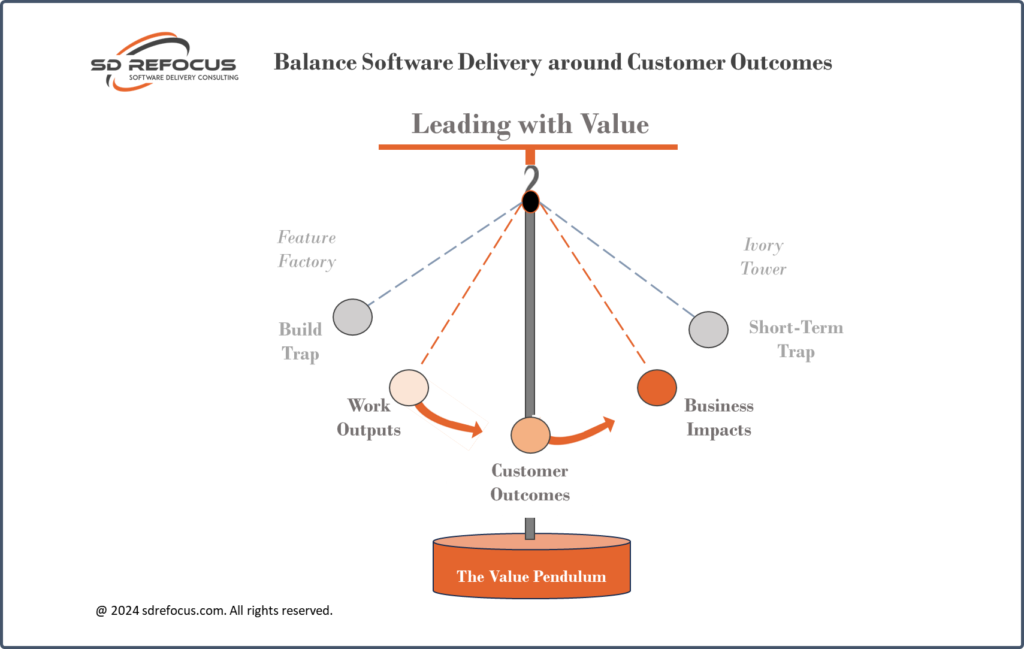
The key to success lies in linking these three types of result in a multiplier effect, rather than seeing them in opposition to one another as in the traditional view. If employees are happy and focused on producing Outputs that drive Customer Outcomes, this increases the likelihood of generating positive Business Impacts for the organization.
All three dimensions are essential and interrelated, and depending on the circumstances, we place varying degrees of emphasis on each. If an excessive amount of emphasis is placed on one dimension to the detriment of the other two, the system is no longer viable in the long term.
Managing software delivery is a balancing act!
While the three types of results are closely linked, Customer Outcomes are of particular importance. In fact, we oscillate between the three dimensions, with a balance point centered around Customer Outcomes.
If the balance is disrupted by internal considerations, the company may fail to meet its customers' expectations over the long term.
You have to keep an eye on the big picture to avoid falling into the usual traps of an unsustainable "Feature Factory" or a short-sighted "Ivory Tower."
Six Key Questions to Help You Get Started
Q1- CHANGE: How will our transformations generate the beneficial changes we hope for?
Pains to be addressed: No clear link between our work and the expected results.
Gains to be achieved: Well-founded rationale, greater teams and leadership buy-in.
Your level of confidence in your ability to answer the question? Low - Medium - High
We can leverage the expertise developed in the field of social and environmental programs to build our understanding of the pathways to software value realization.
A Logic Model is the foundation for understanding the causal relationships between our activities, work outputs, changes in customers & users experience (outcomes), and contributions to achieving the company's strategic business goals (impacts). These models provide a clear rationale for proposed interventions, enabling investors to fund change initiatives:
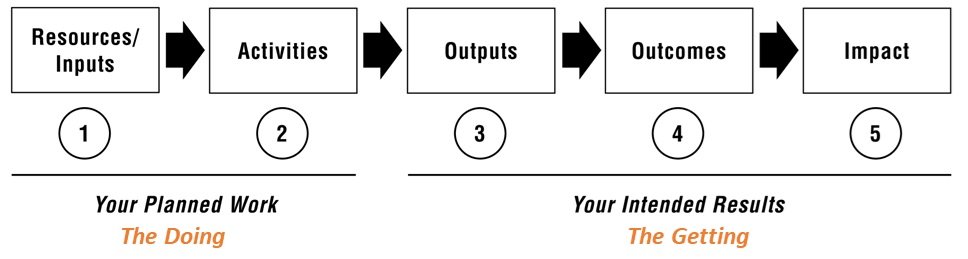
Source: « Logic Model Development Guide » by W.K. Kellogg Foundation, 2004
We strongly recommend that you begin with collaborative workshops to discuss the rationale for the envisioned changes. These workshops are essential for building momentum and breaking the status quo of "we've always done it this way"!
Q2- VALUE: Does our work bring value to our customers and users?
Pains to be addressed: Unclear direction, distance from customer concerns.
Gains to be achieved: Customer-centric intended benefits.
Your level of confidence in your ability to answer the question? Low - Medium - High
In alignment with the tenets of Lean Thinking, start with gaining a clear understanding of what your customers value. In fact, it's all about clarifying the Value Proposition for different customer segments or profiles with their jobs, gains and pains.
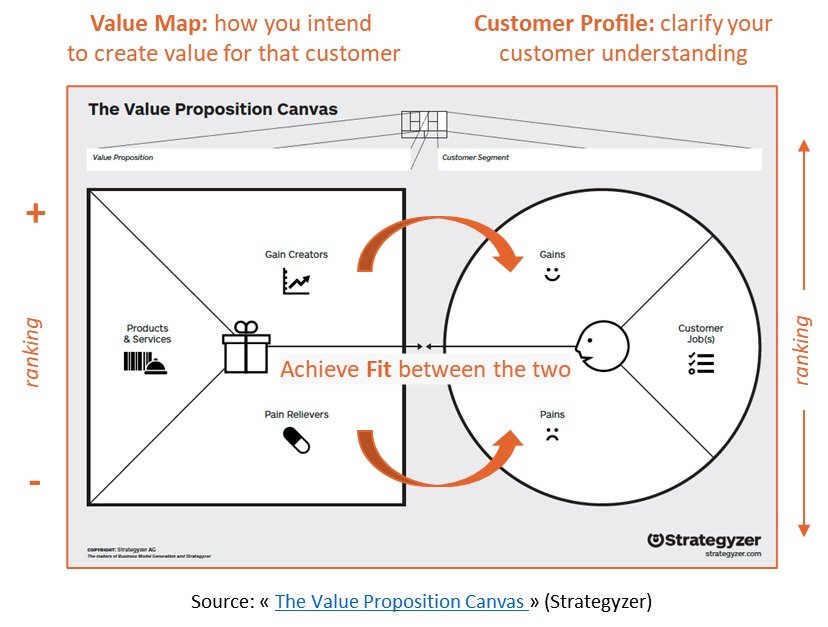
The next step is to identify and rank the elements of value (gain creators and pain relievers) that matter most to your customers.
To succeed, you must continuously adapt and adjust the market fit of your products and services to align with your customers' evolving expectations.
Q3- IMPACTS: Are we contributing to the achievement of the company's strategic objectives?
Pains to be addressed: Disconnects between strategy and operational execution.
Gains to be achieved: Clear alignment with corporate goals.
Your level of confidence in your ability to answer the question? Low - Medium - High
In addition to clarifying the benefits we offer our customers; we must ensure the economic viability of our business by establishing a clear and aligned vision of strategic goals.
It is the responsibility of executives and leadership teams to set the long-term direction, communicate it, and ensure that everyone is aligned with the company's strategic priorities.
A recommended way of doing this is to define OKRs (Objectives and Key Results) expressed in terms of customer outcomes and business impact for the company, and not as a traditional list of activities producing outputs.
The identification and organization around Value Streams must also be aligned with our business goals.
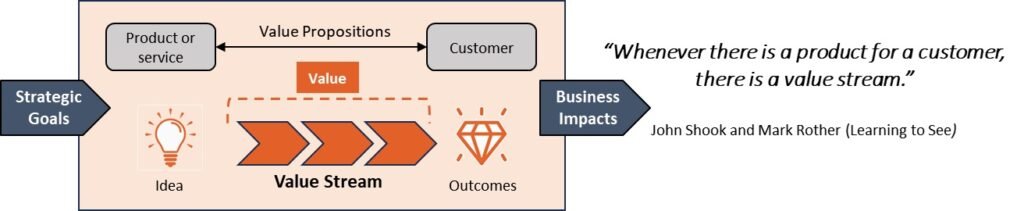
Q4- DRIVERS: Which customer behaviors drive our business results?
Pains to be addressed: Ignorance of what drives our success.
Gains to be achieved: Known Value Paths.
Your level of confidence in your ability to answer the question? Low - Medium - High
While the two previous challenges—clarifying customer value and the company's strategic objectives—may not be immediately apparent and are often overlooked, this one is of paramount importance for the company's or product's survival.
The aim here is to develop a detailed Logic Model that enables us to understand both links:
- between customer experience and business impacts, for instance by defining a North Star Metric;
- between our capabilities and customer experience changes, leveraging industry knowledge like the Core Model from DORA Research:
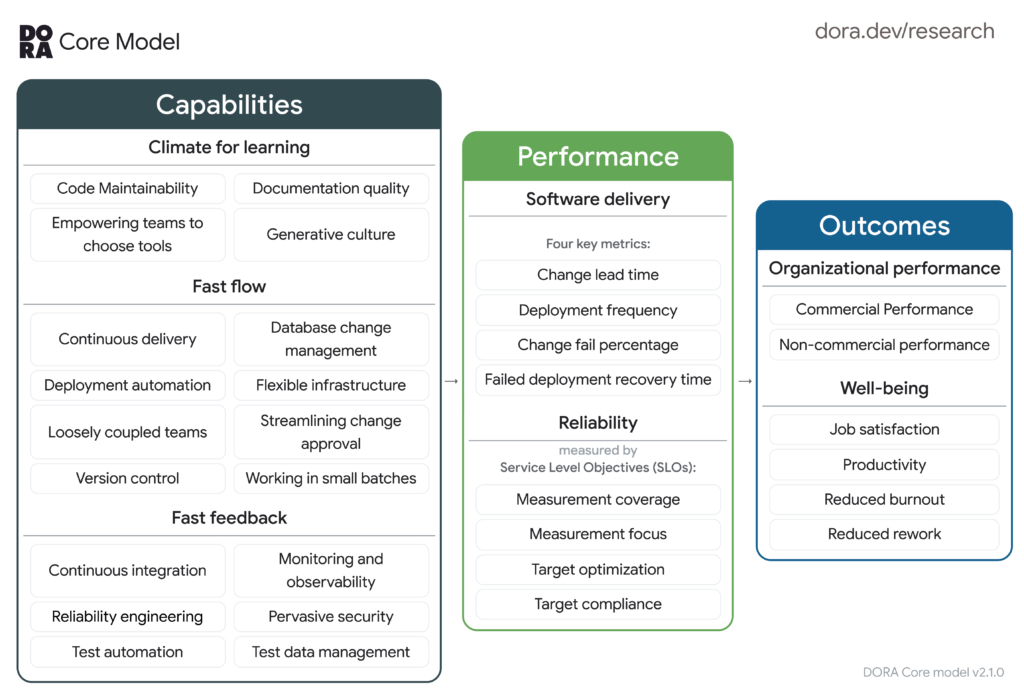
Source: « DORA Core Model » by DORA Research
Q5- FOCUS: Where should we focus our capabilities and improvements?
Pains to be addressed: Disruptions and distractions between all the activities to be carried out.
Gains to be achieved: Carrying out pivotal actions.
Your level of confidence in your ability to answer the question? Low - Medium - High
The previous elements set out the priority directions we should be pursuing. To focus our energies on what matters most, we need to make operational decisions based on these orientations. We must decide on the activities to be carried out on the product and the improvements to be made to the operating model.
To be able to focus on worthwhile improvements, it is essential to visualize the efficiency of the entire workflow and understand its effectiveness in delivering the intended value. Collaborative Value Stream Mapping workshops are essential techniques for achieving this.
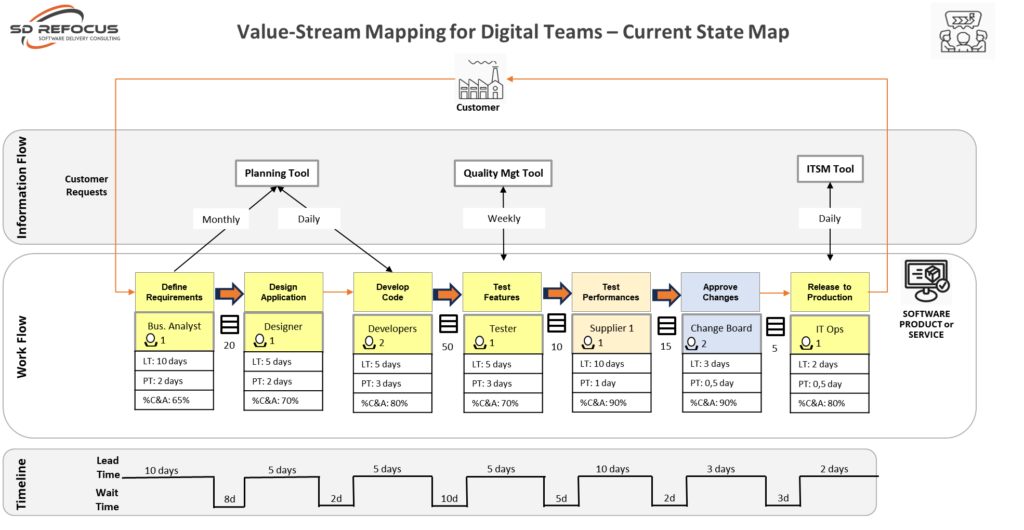
Q6- PROGRESS: - Are we making measurable, tangible progress?
Pains to be addressed: Inability to show progress.
Gains to be achieved: Making sharp decisions.
Your level of confidence in your ability to answer the question? Low - Medium - High
Measurements support the company's culture of learning. They help business and technology leaders make sharp decisions about how to maximize value.
Get a complete view of your end-to-end flow of value, combining strategy, product, engineering, flow, customer and business metrics using Value Stream Management Platforms (VSMPs) and Kanban boards.
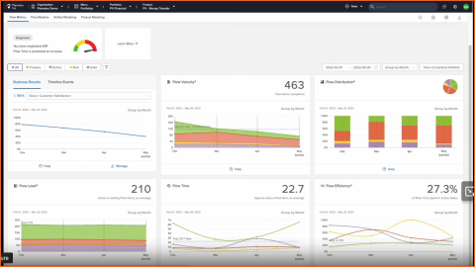
Source: Planview VSM Online Demo
What's Next?
How would you rate your level of confidence in your ability to answer the six questions above?
If you're interested in these first extracts, contact us now to find out more about the e-book, the twenty or so techniques referenced in the accompanying toolkit, or simply to book a free consultation.